Showing posts with label Therefore. Show all posts

Saturday, April 3, 2010

Therefore it shall come to pass . . .

Therefore it shall come to pass, when the Egyptians shall see thee, that they shall say, This [is] his wife: and they will kill me, but they will save thee alive.
Genesis 12:12 KJV

Lying. Never a good idea. No matter how justified it seems at the time. But here is Abram, soon to be renamed Abraham, and the guy mentioned so prominently in Hebrews 11's Hall of Faith, talking his beloved wife into lying on his behalf.

Of course we would never do such a thing. But, consider this. I am at first struck at Abram’s concern over his 60-year-old wife’s attractiveness to the Egyptians. This shows Sarai was not only a woman of particular beauty, but also that not every culture worships youthful and the ultra underweight appearance the way our own modern day culture seems to.

As an aside, there is an interesting Jewish legend about Abram and Sarai's travels into Egypt. It goes like this:

The ancient Jewish legend tells that when Abram went down into Egypt, he tried to hide Sarai in a casket. When the Egyptian customs officials asked what he had in the casket, he said, “barley.”

“No,” they said, “it contains wheat.”

“Very well,” answered Abram. “I’ll pay the custom on wheat.”

Then the officers said it contained pepper. Abram said he would pay the custom charges on pepper. Then the officers said it contained gold. Abram said he would pay the custom charges on gold. Then the officers said it contained precious stones. Abram said he would pay the custom charges on precious stones.

By this time, the officers suspicions were aroused beyond control and they insisted on opening the casket. When they did, all of Egypt shined with the beauty of Sarai. Other similar legends say that in comparison to Sarai, all other women looked like monkeys. And some say that she was even more beautiful than Eve.

Now, all of that is the stuff of legends. But, I think it demonstrates that Abram had a good reason to be concerned for her safety and certainly his!

So, Abram asks her to say that she is his sister. Now, this was actually a half-truth. Sarai was Abram’s half sister (see Genesis 20:12). But here is the spiritual principle.

A half-truth is a whole lie.

Abram’s intent here was clearly to deceive the Egyptians and protect his own life and Sarai's. He trusted in his clever deception to protect him instead of trusting in the Lord who had made a covenant with him.

So, what is it there for?

It is there to point out two potential ways of dealing with a situation that is beyond our own understanding or control.

First, if you lack faith or you want to do something to advance your own cause, you can almost always find plenty of good reasons to do it or say it. If you can’t think of the reasons yourself, the devil is happy to suggest them.

Second, Abram would say, “God has made a covenant with me about my descendants and He has promised me children, and I don’t have them yet; therefore, I know that I am 10 feet tall and bulletproof until the time that God’s promise is fulfilled, because God’s promises are always true.”

Fortunately for Abram, his life was not permanently marred by this decision.  After all, he is mentioned prominently throughout the Bible and is the Father of the Jewish nation.

Where do you stand today?  Are you in fear because God has not delivered on His promises to you yet?  Or are walking in faith as someone who is 10 feet tall and bullet proof?

Photo licensed under the following terms: http://www.sxc.hu/txt/license.html

Saturday, January 30, 2010

Therefore is the name of it called Babel

Therefore is the name of it called Babel; because the LORD did there confound the language of all the earth: and from thence did the LORD scatter them abroad upon the face of all the earth.
Genesis 11:9 KJV

It is amazing what we can do if we put our minds to it. That goes for both good and evil. Fallen mankind has shown an incredible capacity for evil. Just look at history -- Sodom, Jesus' crucifixion, the Holocaust, the killing fields of Cambodia, just to name a few.

Nothing we do is beyond the view of God. This is clearly demonstrated in the story of the Tower of Babel. Mankind was cooperating. And that's a good thing, right? I mean, could we all "just get along" as someone once said in the midst of a terrible riot. But, I guess that depends on what we are trying to accomplish.

In this story man is trying to build a tower that reaches all the way to the heavens. I am not even going to ask why if you want to build a tower to the heavens you would build it on the Plains of Shinar instead of the nearby mountains. I mean, wouldn't the mountains sort of give you a head start height wise?

Apparently man was succeeding in his efforts. So much that God decided to take a closer look. And what he saw showed that man had already forgotten the miracle of God's protection for Noah and his family on the Ark.

The heart of Noah's descendants and the bricks and asphalt used to build the tower of Babel show that it was not only disobedient to God’s command to fill the earth as God commanded in Genesis 9:1, but it also shows they did not believe God’s promise to never again flood the earth. A waterproof tower was being made to “protect” man against some potential future deluge.

So, what is it there for?

This story is there to remind us that God's promises are true and they are never ending. man has always gotten into trouble when we have lost sight of that. And it is there to demonstrate more of God's mercy than God's judgment. God, in separating man linguistically and geographically, put a check on the power of his fallen nature. In actuality, God was reaching out in grace and was trying to keep man from further damaging the relationship between God and man.

The whole account of what happened at Babel with its organized rebellion against God, and its direct distrust of God’s promise shows man hasn’t gotten any better since the flood. Time, progress, government, and organization have made man better off, but definitely not any better.

But from this point forward God will begin to make man better, and He will start as He always starts: with a man who will do His will, even if he does not do His will perfectly. The story of the Tower of Babel moves quickly from this point and begins to tell the story of Abram. Abram, who would some day become Abraham, the father of the Jewish nation.

But that's another story . . .


Photo licensed under the following terms: http://morguefile.com/license/morguefile/

Saturday, December 26, 2009

Therefore, the Lord God sent them forth

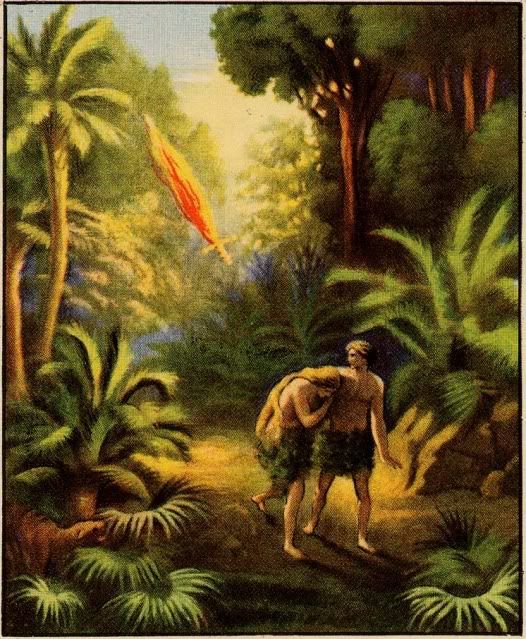
Therefore the LORD God sent him forth from the garden of Eden, to till the ground from whence he was taken. So he drove out the man; and he placed at the east of the garden of Eden Cherubims, and a flaming sword which turned every way, to keep the way of the tree of life.
Genesis 3:23-24 KJV

Oh, so you mean there is a penalty for sin?  But that is not the way the world seems to operate today.  Many seem to operate today in a "consequence free" zone.

These are my thoughts as I take a little longer look at the passage that I addressed a little while ago.

In one sense, God divorced Adam and Eve.  He turned them out of the Garden, and further,  He kept them  out.  God turned him out from the sublime to the common. This is mentioned twice: He sent him forth (v. 23), and then He drove him out, v. 24. In today's parlance that would sound like this; "Get out and stay out!"

God told them get out, told them that that was no place for them, and they would no longer occupy and enjoy that garden. But they liked the place too well to be willing to leave, and therefore God drove them out.  God made them go out, whether they wanted to or not.

This signified an exclusion or separation for them, and all future mankind, from that communion with God and from walking with God in the cool of the day that defined the paradise that was the garden of Eden. The tokens of God’s grace and favor to them were now suspended. And Adam became weak and mortal in that very moment.  He became like other men, such as Samson when the Spirit of the Lord had departed from him.

But where did God send them when He turned them out of Eden?

He might justly have chased him out of the world (see Job 18:18), but God only chased them out of the garden.

He might justly have banished them down to hell, as He did the angels that sinned when He cast them out from Heaven (see 2nd Peter 2:4). But man was only sent to work the very ground out of which they were taken. He was sent to a place of toil, not to a place of eternal torment.

He was sent to the ground, not to the grave.  He was sent to the daily grind, not to the dungeon.

He was sent to hold the plow, not to the pinion.

So, what is it there for?

By working the land man would be rewarded by his eating of its fruits.  And this would serve to keep man humble. Observe, then, that though our first parents were banished from the Garden and its privileges by their sin, they were not abandoned to despair.  God already had a plan.  God’s thoughts of love were already designing them for a way of salvation with new terms. God was looking down the long road of history and looking at a manger and at a cruel cross. 

I think it is appropriate to end with Romans 5:8.  It says;

But God showed his great love for us by sending Christ to die for us while we were still sinners.

Photo is in the public domain 


Friday, August 28, 2009

What's it there for?

Such was the question that was posed by the evangelist one night during a revival service so many years ago.  He was preaching with great passion and power.  And he came to a passage in the Bible that began with "Therefore . . ."

He paused.

And then he said, "Whenever you come across the word 'Therefore' in a Bible verse, you need to pause for a while, read it again, study it and figure out just what it is there for." 

That was good advice many years ago.  I have not come across a verse in my Bible reading since that night that I have not thought about what that preacher said.  Now I must confess.  Sometimes I began that reading and studying right there on the spot.  And sometimes that was in another church service when another preacher was preaching.

So, I apologize for that!  But not for the great Biblical adventure that began that night!

My other blog is going fine.  But, I had a desire to create this one and see where it takes me.  I hope you will be an active participant in the dialog.

After all, isn't that what blogs are there for?

Photo used under the following license agreement: http://creativecommons.org/licenses/by/2.5/