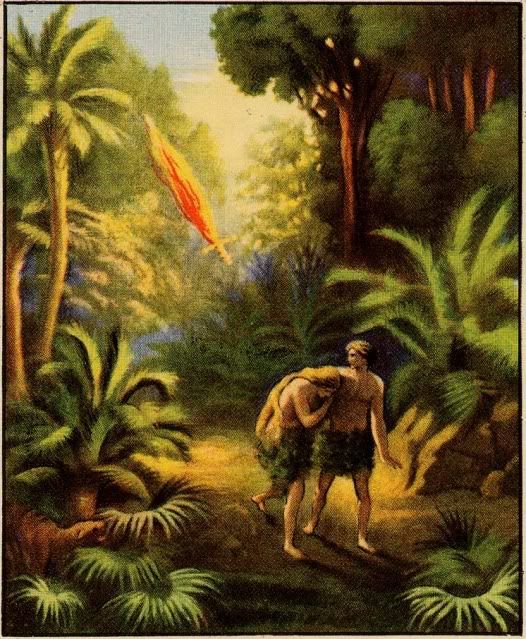
 Therefore the LORD God sent him forth from the garden of Eden, to till the ground from whence he was taken. So he drove out the man; and he placed at the east of the garden of Eden Cherubims, and a flaming sword which turned every way, to keep the way of the tree of life.
Genesis 3:23-24 KJV
Oh, so you mean there is a penalty for sin? But that is not the way the world seems to operate today. Many seem to operate today in a "consequence free" zone.
These are my thoughts as I take a little longer look at the passage that I addressed a little while ago.
In one sense, God divorced Adam and Eve. He turned them out of the Garden, and further, He kept them out. God turned him out from the sublime to the common. This is mentioned twice: He sent him forth (v. 23), and then He drove him out, v. 24. In today's parlance that would sound like this; "Get out and stay out!"
God told them get out, told them that that was no place for them, and they would no longer occupy and enjoy that garden. But they liked the place too well to be willing to leave, and therefore God drove them out. God made them go out, whether they wanted to or not.
This signified an exclusion or separation for them, and all future mankind, from that communion with God and from walking with God in the cool of the day that defined the paradise that was the garden of Eden. The tokens of God’s grace and favor to them were now suspended. And Adam became weak and mortal in that very moment. He became like other men, such as Samson when the Spirit of the Lord had departed from him.
But where did God send them when He turned them out of Eden?
He might justly have chased him out of the world (see Job 18:18), but God only chased them out of the garden.
He might justly have banished them down to hell, as He did the angels that sinned when He cast them out from Heaven (see 2nd Peter 2:4). But man was only sent to work the very ground out of which they were taken. He was sent to a place of toil, not to a place of eternal torment.
He was sent to the ground, not to the grave. He was sent to the daily grind, not to the dungeon.
He was sent to hold the plow, not to the pinion.
So, what is it there for?
By working the land man would be rewarded by his eating of its fruits. And this would serve to keep man humble. Observe, then, that though our first parents were banished from the Garden and its privileges by their sin, they were not abandoned to despair. God already had a plan. God’s thoughts of love were already designing them for a way of salvation with new terms. God was looking down the long road of history and looking at a manger and at a cruel cross.
I think it is appropriate to end with Romans 5:8. It says;
But God showed his great love for us by sending Christ to die for us while we were still sinners.
Photo is in the public domain




 Posts
Posts


